Central Asia
Kalyan Mosque
Background
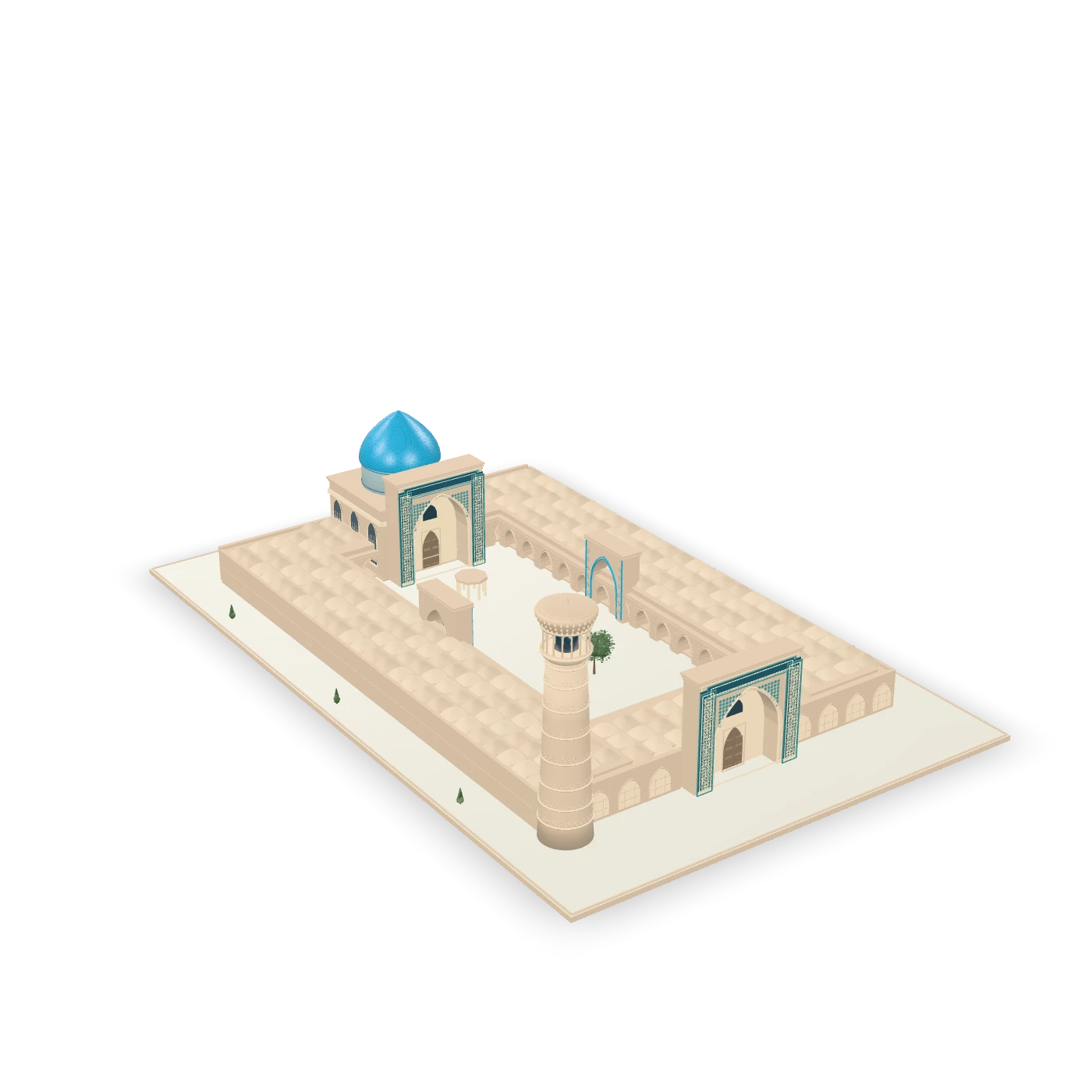
In the twelfth century a Friday mosque built under the Karakhanid ruler Arslan Khan stood on the site of the present one; only the Kalyan Minaret survives from it. Under the present building archaeologists found the remains of two earlier mosques. The mosque took its present form in the early sixteenth century under the Shaybanids: in 1514 Ubaydullah Khan had it thoroughly rebuilt, with majolica on the facade and a mosaic mihrab.
The building is rectangular, about 130×80 metres, with four iwans on the sides of the courtyard. The galleries around the courtyard rest on 208 piers and are covered by 288 domes. A blue dome on a mosaic drum rises above the chamber with the mihrab; the name of the master Bayazid Purani is preserved in the ornament.
In 1542 a marble slab was set into the entrance portal bearing a decree of Abdulaziz Khan that freed the people of Bukhara from some taxes. The mosque did not function during the Soviet decades; it was later handed to the Muslim Board of Uzbekistan and in 1997 was repaired for the 2500th anniversary of Bukhara. Since 1993 it has been part of the UNESCO World Heritage site Historic Centre of Bukhara; Friday and festival prayers are held here today.
Compare
Capacity, peopleNo. 9 of 10. 223,000 people less than the leader.
- 1Astana Grand MosqueAstana235,000
- 2Imomi Azam MosqueDushanbe133,000
- 3Imam Bukhari MosqueKhoja Ismail, near Samarkand45,000–50,000
- 4Seitzhan Qari Yeszhanuly MosqueShymkent≈ 22,000
- 5Sulaiman-Too MosqueOsh20,000
- 5Imam Sarakhsi MosqueBishkek20,000
- 7Yusufxon o‘g‘li Qosimxon MosqueNamangan15,000
- 8Islomobod MosqueTashkent13,000
- 9Kalyan MosqueBukhara12,000
- 10Türkmenbaşy Ruhy MosqueGypjak10,000
Uzbekistan 4 · Kazakhstan 2 · Kyrgyzstan 2 · Tajikistan 1 · Turkmenistan 1
On the map
Artistic 3D models of 10 of the largest mosques in Central Asia. This is not a complete ranking. Fine ornaments and some architectural details are simplified.