Central Asia and the world
Tashkent Tower
Background
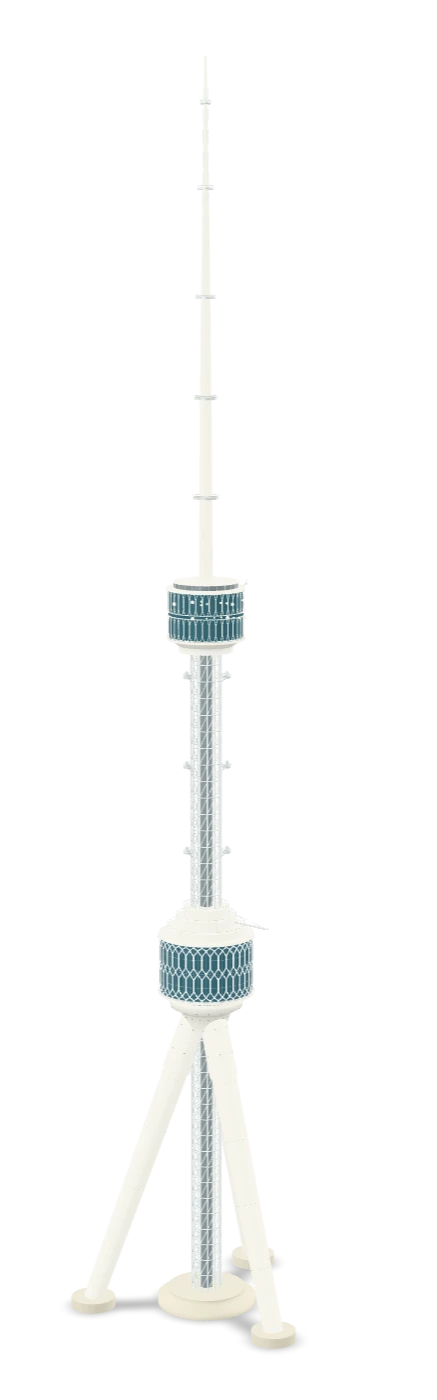
By the 1970s the old 180-metre tower of 1956 could no longer carry the growing number of television and radio programmes. On 1 September 1971 a directorate for building a new transmission centre started work under the Ministry of Communications of the Uzbek SSR. The design is by the architects Yu. Semashko and N. Terziev-Tsarukov and the structural engineers E. Morozov and M. Musheev. Construction began in April 1978, and the tower was commissioned on 15 January 1985.
The tower is all steel: three inclined legs, each 93 metres high, brace the shaft. Steel was chosen because it suited a seismic area better than the alternatives. The foundation was ready in four months and took 11,000 cubic metres of concrete and 1,000 tonnes of reinforcing steel. The tower weighs about 6,000 tonnes.
The observation deck and the revolving Koinot restaurant are about 100 metres up. In 1990 the tower joined the World Federation of Great Towers, and a Cabinet of Ministers decision of 4 October 2019 put it on the national register of cultural heritage sites. Since 16 November 2019 visitors' identity documents are no longer checked. The tower broadcasts to Tashkent, Tashkent Region, part of Syrdarya Region and the southern districts of Kazakhstan.
Compare
Height, mNo. 1 of 14 in Central Asia. 3.5 m more than second place.
Central Asia
- 1Tashkent TowerTashkent375
- 2Kok Tobe TV TowerAlmaty371.5
- 3Turkmenistan TowerAshgabat211
- 4Dushanbe TV TowerDushanbe197
- 5Bishkek TV TowerBishkek193
- 6Aktobe TV TowerAktobe180–192
- 6Petropavl TV TowerPetropavl180–192
- 6Pavlodar TV TowerPavlodar180–192
- 9Old Tashkent TV TowerTashkent180–186
- 10Kostanay TV TowerKostanay180
- 10Taraz TV TowerTaraz180
- 10Astana TV TowerAstana180
- 10Atyrau TV TowerAtyrau180
- 14Kyzylorda TV TowerKyzylorda148
World leaders
- 1Tokyo SkytreeTokyo634
- 2Canton TowerGuangzhou600
- 3CN TowerToronto553.33
- 4Ostankino TowerMoscow540.1
- 5Oriental Pearl TowerShanghai468
Kazakhstan 9 · China 2 · Uzbekistan 2 · Japan 1 · Canada 1 · Russia 1 · Turkmenistan 1 · Tajikistan 1 · Kyrgyzstan 1
On the map
Artistic 3D models of 19 TV towers. The shapes are based on photographs; some details are simplified.